Direct Ownership Changes
As an extended part of Workday's prescribed consolidations approach, this article covers direct ownership changes.
Company 1001 is 100 percent owned by Company 1002. On March 1, 2019, the ownership changes to 70 percent owned by Company 1002 and 30 percent owned by a third-party or a company outside the reporting hierarchy.
Company 1002 is 100 percent owned by Company 1003.
Company 1002 is the direct owner of Company 1001 and Company 1003 is the indirect owner of Company 1001.
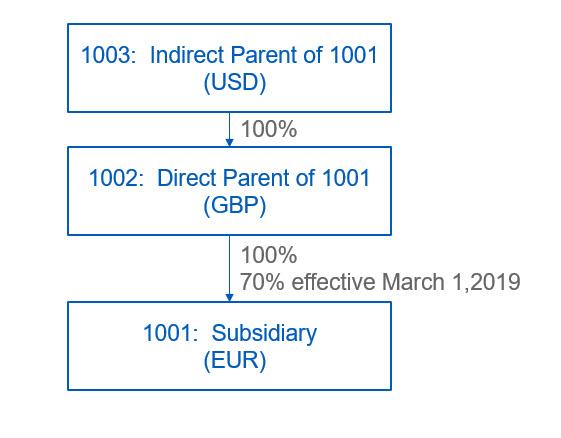
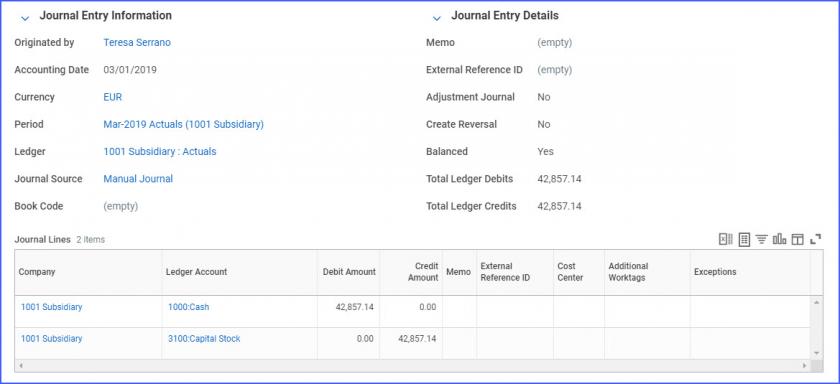
The March 1 ownership change is the result of the subsidiary receiving an injection of capital from a third-party. As a result, the parent's ownership is reduced to 70percent. Because nothing has changed on the parent's side, other than a reduction in ownership, there are no changes to the parent's investment in sub accounts.
Below is the journal entry for the injection of capital received by the subsidiary:
Company Ownership Details:
Note: If the report below isn't available in your tenant, you can configure it using an advance report structure. The data source is Ownership Details for Companies.
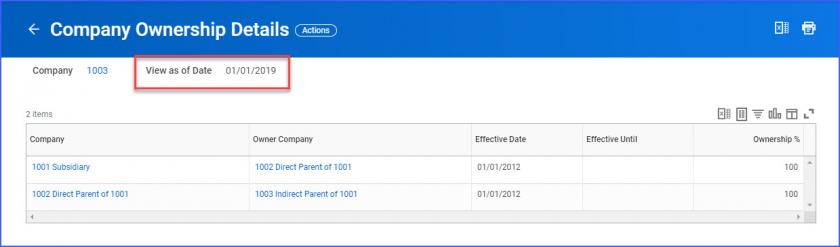
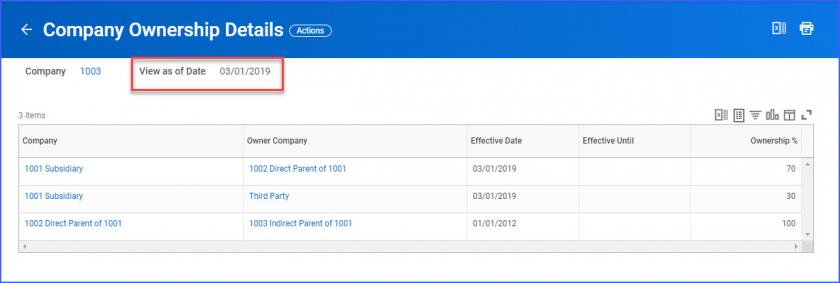
Elimination Rules Applicable to Direct Ownership:
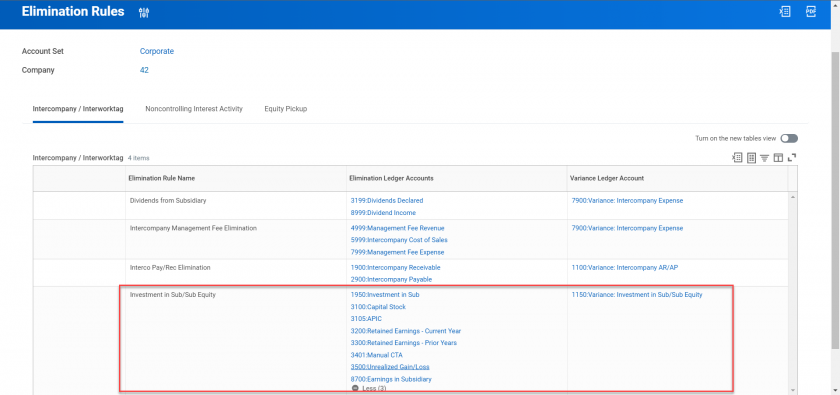
Intercompany/Interworktag Tab - Tag the equity accounts on the subsidiaries with the intercompany affiliate of one or more parents in order to be correctly eliminated.
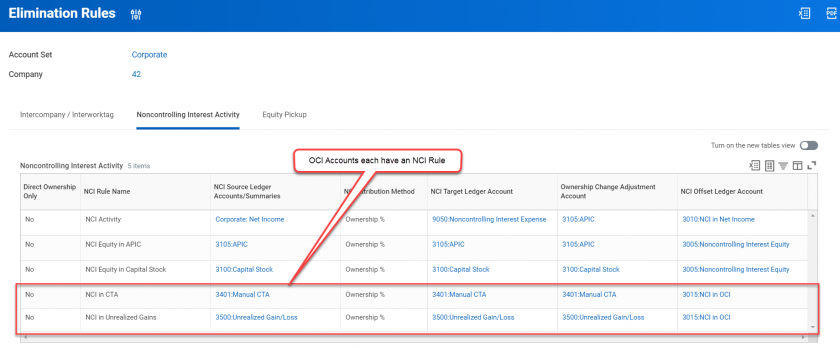
Noncontrolling Interest Activity Tab - The Current Year Retained Earnings Offset Ledger Account is the account where the impact from the ownership change is displayed in the elimination column. This is necessary since Workday will calculate the amount for the NCI Target Ledger Account based on the effective date of the ownership change (in our example, the amount for 9050 will be 100 percent of Net Income through the end of February and 70 percent of Net Income from March 1) and the amount in the NCI Offset Ledger Account based on the period end ownership (70 percent of the Net Income to date).
Equity Pickup Tab
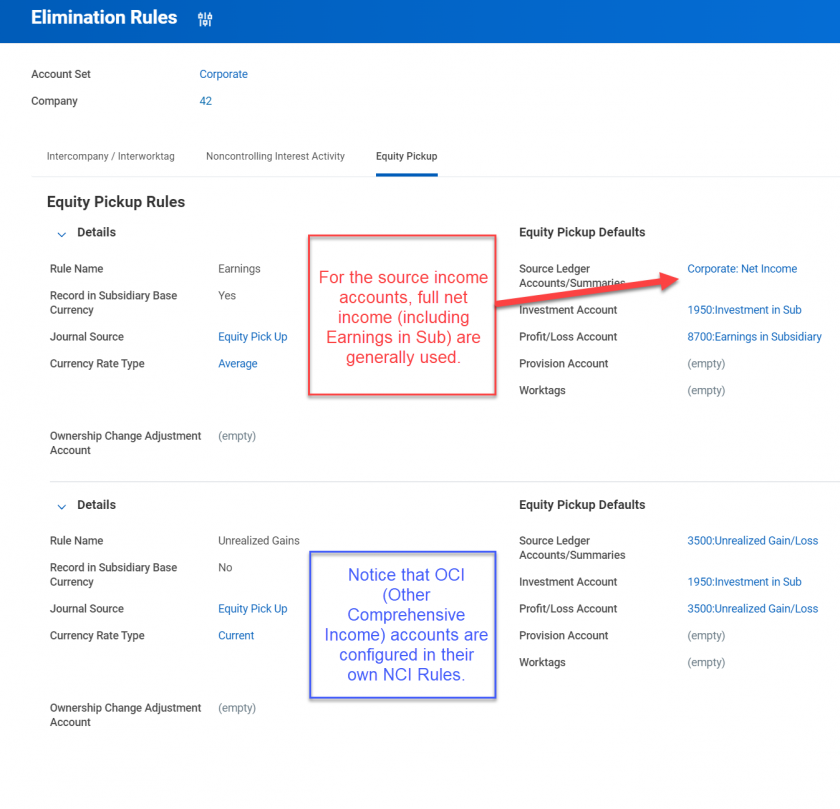
Even though we include the equity pickup elimination rules (see above), our first example won't use equity pickup (refer to Example #2 further below to view the equity pickup entries).
Example 1 (Without Running Equity Pickup):
The consolidated trial balance before the ownership change (for comparison purposes only):
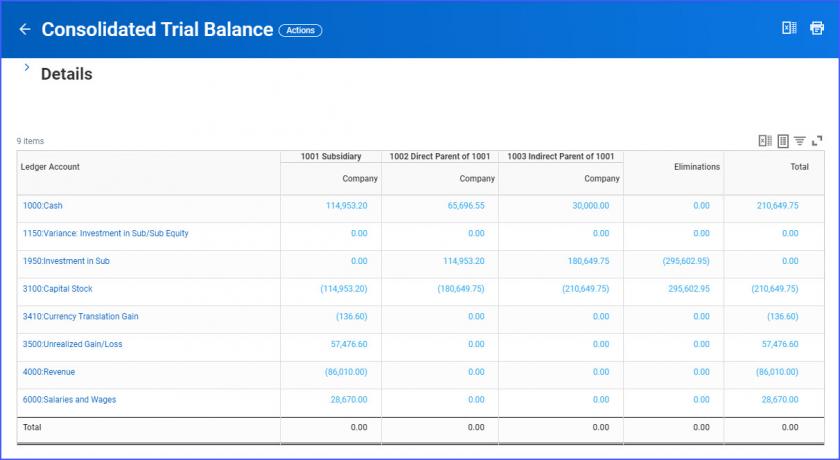
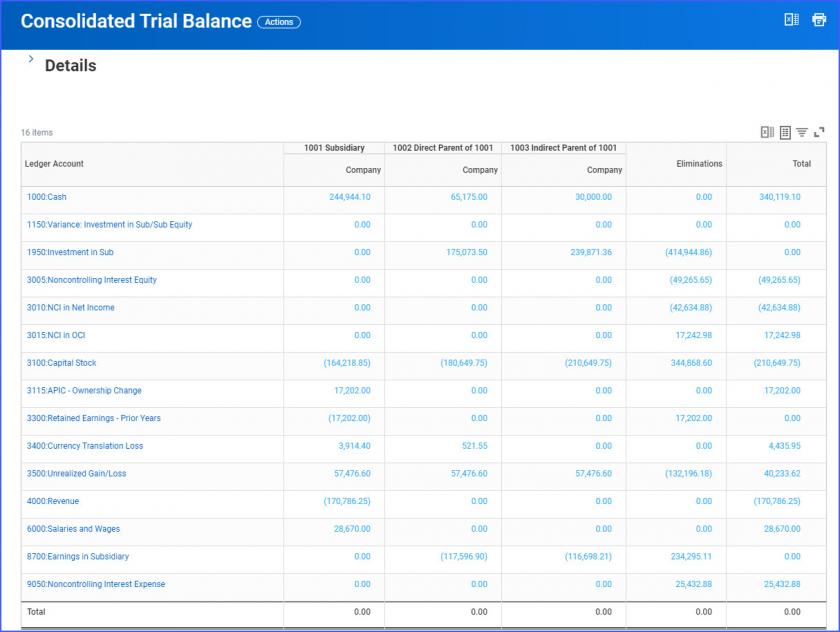
The consolidated trial balance after the ownership change:
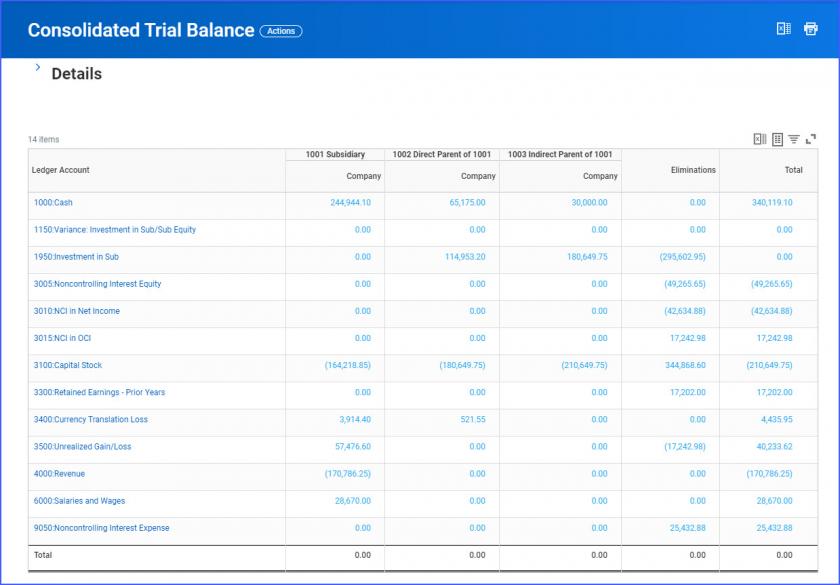
For the purposes of this example, assume that the only transactions are the capital infusion on 1001 as shown above and 75,000 Euro in revenue recorded on 1001 after March 1, 2019.
These entries are displayed in the Elimination column (all translated to U.S. dollar):
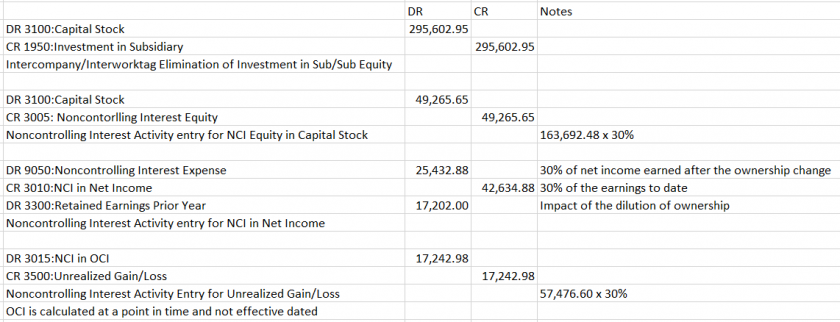
The debit entry to 3300: Retained Earnings Prior Year is driven by the account specified in the Current Year Retained Earnings Offset Ledger Account in the Noncontrolling Interest Activity Tab elimination rule for NCI in Net Income. Post this dilution impact to a different equity account therefore, an adjustment entry is required to reclass this from Retained Earnings Prior Year to the account desired. In this example, we assume that the desired account is Additional Paid in Capital.
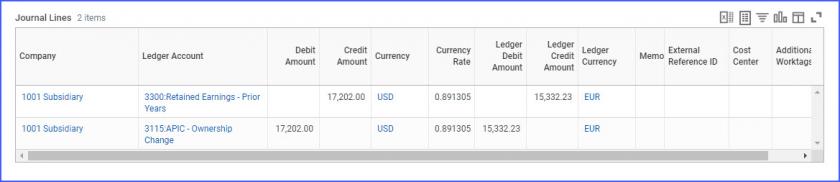
Journal Entry for the Adjustment to the Retained Earnings Elimination:
Note: In our example, we created a new account (Account # 3115) in order to reclass the changes in Retained Earnings. This account won't be included in our elimination rules.
Additionally, it's always best to key this type of adjusting entry to a book code other than the Blank book code, so that you can include or exclude these types of adjusting entries in reports as appropriate.
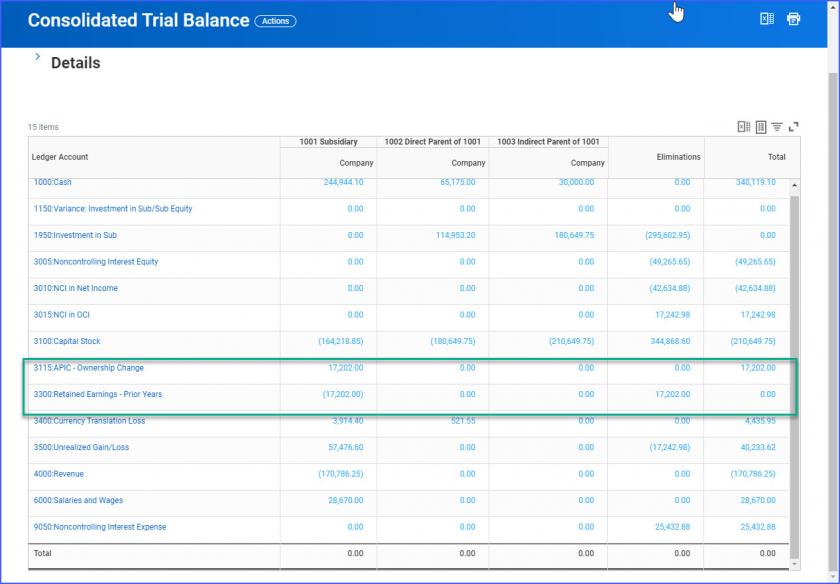
The Resulting Consolidated Trial Balance:
While the elimination column is still displaying the dilution impact in 3300: Retained Earnings Prior Year, the consolidated total of the retained earnings and APIC accounts is correct because the correcting entry was recorded in 1001.
Example 2 (With Equity Pickup):
The consolidated trial balance reflecting equity pickup entries after the ownership change:
Direct ownership is represented in the ownership table for the entity. Each entity would have a parent or parents that make up 100 percent ownership. When direct ownership changes, these steps are required:
- Record an adjustment to capital on the subsidiary
- Record adjustment to investment in subsidiary on the parent (if the parent entity initiated a transaction that caused the ownership change)
- Update the ownership table on the subsidiary