Search Tips for the Workday Community
Overview of Workday Community Search
The Workday Community search is accessible from any page on the Community and includes over 20 types of content.
Search results are tailored to your role, as assigned by your Organization Administrator. For example, only Named Support Contacts (NSCs) have access to view cases, so only they see cases in their Workday Community search results.
The Workday Community Assistant is also available as your researcher. It’s a conversational AI-powered agent that can offer guidance, create plans, and automate tasks. We recommend you to use the Workday Community Assistant when you need guidance on solving a problem, building plans, synthesizing ideas from multiple places, researching, or interacting with platform features. For more information on how to best use the Workday Community Assistant, see here.
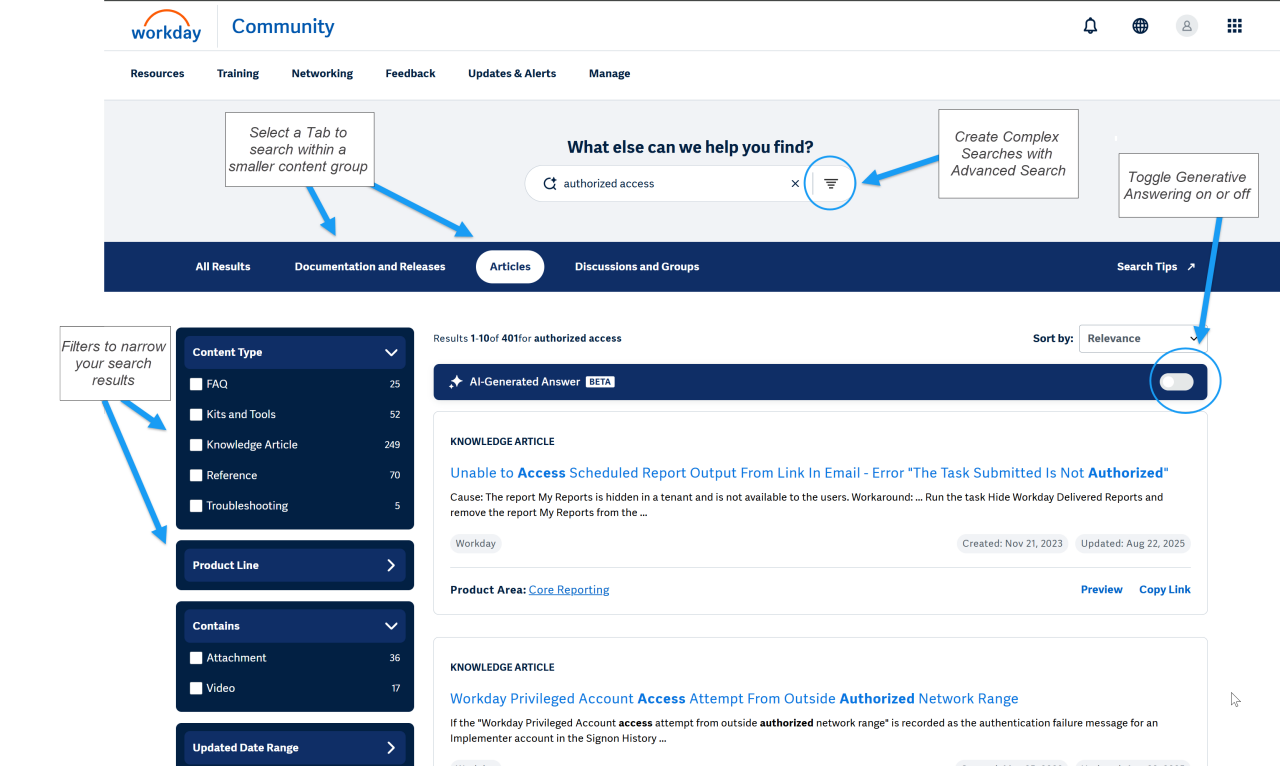
Get the Most Out of Search
There are several powerful tools at your disposal in the Workday Community Search. Become familiar with the following 4 features:
- Advanced Search: The Advanced Search, available in the search bar, provides a way to build a complex query. We describe Advanced Search features in more detail below.
- Generative Answering: To get the best AI-generated answers, include specific context and ask a question. Use filters after you ask your question to improve the results. The cited references include additional details so that you can verify the answer.
- Tabs: Select a different Tab across the top of the Search Results page to reduce the overall scope of your search. While the All Results tab searches all content, other tabs are more specific. For example, if you want to search only within user discussions, questions, posts and solutions, select Discussions and Groups. If you're looking for Workday-authored Troubleshooting, FAQs, Kits and Tools and so on, select Articles.
- Filters: You can use filters to narrow down your search results. When you select a filter, such as Product Line, the Product Area filter displays and you can drill down further. These filters adapt to what you are searching for in real time. For example, if you're searching for a learning course, the Training search facet will automatically appear at the top of your Content Type options.
Advanced Search
In January 2026, the Workday Community introduced an Advanced Search query builder, which replaces the need to learn the query syntax* that's necessary for complex queries with Boolean logic.
The Advanced Search interface is available by clicking the Advanced Search icon on the right of the header Search box:
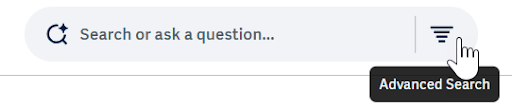
*Power users can start building a query in the Advanced Search query builder and then switch to Custom Syntax if you want to go beyond the capabilities of the builder.
Use Cases for Advanced Search
- You want to find a page with specific words in the title.
- You want to search for a string that includes special characters like square brackets, backslashes, or punctuation (] \ ?) since the header search converts most characters to spaces by default.
- You want to disable stemming. See the Stemming section below for more information
- You have multiple criteria that include some phrases or words but not others.
- You want to find questions or posts by a specific Workday Community member.
- Note: Search currently only searches the 1st question in a post, not the answers.
Search Filters
To narrow your search results, you can either select the Tabs across the top, or the search filters on the left side of the search results page after executing your Advanced Search.
The filters on the left side of the search results page adapt to what you are searching for in real time. For example, if you're searching for a learning course, the Training search facet will automatically appear at the top of your Content Type options.
How to Use the Advanced Search Query Builder
- Click the Advanced Search icon in the search box.
- Use the drop-down menus to specify how the search should handle the keywords words in your query (see more details in the next 2 sections).
- Enter the keywords or phrase to consider into the Key Words field.
- To add another condition, use the operator drop-down menu to select AND, OR, and NOT at the beginning of the next condition.
- Use the plus icon (+) to add up to 6 more rows and the minus icon (-) to remove rows.
- Note: A query won't execute if any row is incomplete.
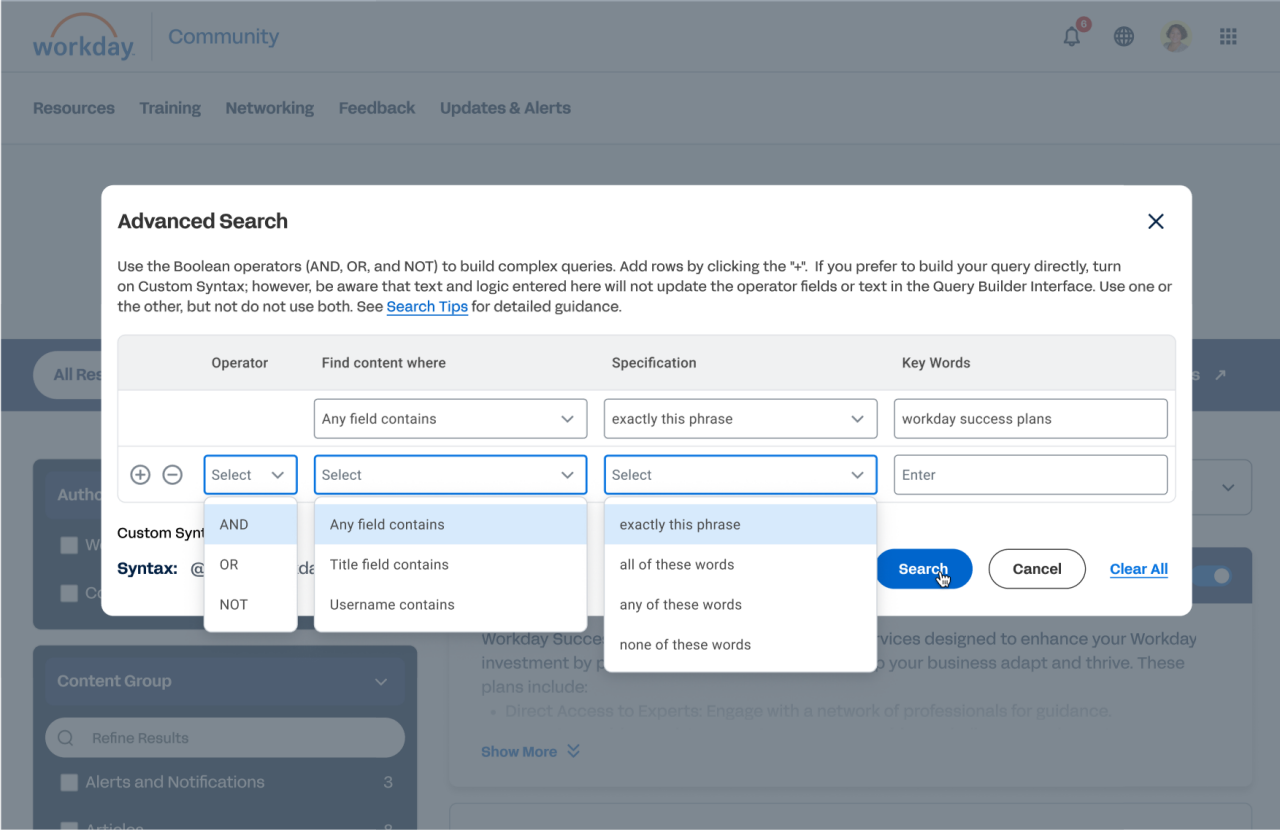
Menu: Find Content Where
- Any field contains: This searches all fields of the page, including the username, title, and several fields for the body of the page.
- Title field contains: This searches for words only found in the title of the document.
- Username contains: This searches for the username of a Workday Community member who created the page, such as jdoe1000.
Menu: Specification
- Exactly this phrase:
- Search for results that contain all words in the exact order you entered them.
- This is equivalent to searching within double-quotes, and is especially helpful if you're searching for special characters (* [ % . \) which are treated as spaces in the main search.
- Pro tip: If you happen to prefer to type the query syntax directly, be sure to use straight quotes ("). Curly quotes (“) don't work.
- All of these words:
- Search for results that contain all the exact words (no stemming), but the words don't need to be next to each other or in any particular order.
- This is equivalent to searching: +Job AND +Profile AND +HCM
- Any of these words:
- Search for results that contain one or more of the words you've entered.
- This is equivalent to searching: +secure OR +roth OR +ira OR +2026
- None of these words:
- Excludes results that include any of the key words. This selection is best used as an elimination strategy in the 1st line.
- This is equivalent to searching +Job OR +Work OR +Occupation
- Pro tip: If you have a 2nd condition in your query builder, we recommend that you use the NOT operator before the 2nd condition, instead of None of these words, because it gives you more flexibility to use Exactly this phrase to remove an entire string. If you use both NOT and None of these words in the same line, they could cancel each other out.
Stemming and Advanced Search
What is stemming? Stemming searches for words with the same stem even if they don't match the search terms exactly. For example, if you search for the word resolve, you get results for resolve, resolved, resolving, and resolves.
By default, search enables stemming. If you want to stop stemming, you can add a plus sign (+) in front of a word or use the Advanced Search, which blocks stemming by default.
If you want to build a complex search AND continue to have stemming enabled, you can:
- Build your query in the Advanced Search query builder.
- Turn on Custom Syntax.
- Remove the plus signs (+) in front of the words.
- Search!
AI-Generated Answers
The Relevance Generative Answering (RGA) capabilities in Workday Community search enable you to ask the search engine a specific question, and get a summarized answer!
Currently, only Workday-authored content is used in the generated answers. Today the RGA includes:
- Documentation (User Guides and Administrator Guide)
- Release Notes
- Community Reference, FAQ, Troubleshooting, Kits and Tools
- Knowledge Articles
- Calendar Events
- Announcements
- Contributed Solutions (from last 3 yrs)
- Partner Solutions
Our AI-generated answers currently don't include:
- Discussions
- Questions
- User Group Posts
- Ideas
- Training
Generative AI answers display in search results when:
- Your question is specific and includes sufficient detail. Avoid broad or vague queries. Instead of typing keywords, ask a question. For example, How do I create…? Or What are the steps to…in Benefits?
- Relevant and adequate information about your search query currently exists within official Workday-authored content.
- The words in your search query are similar to the words in the relevant Workday-authored content.
Generative AI Search Tips
- Be specific in your search question. Include the product area that you're asking about and any special context.
- Use question words, such as How can I set up an EIB spreadsheet? Instead of simply EIB spreadsheet.
- As with all generative AI tools, validate the AI-generated answer by reviewing the citation.
- If you don’t find what you are looking for, look at the pages cited in the Generative Answer and the search results below.
Query Syntax
If you like to type your own query syntax by hand or start building one in the Advanced Search query builder, you can toggle to the Custom Syntax mode and edit it manually.
Here's a quick reference for search syntax that you can use:
"exact text?"
Use quotation marks for exact phrase match (no stemming). Occasionally, you might see other search results that machine learning suggests in addition to the ones with your quoted text. The intention is to enrich your search experience with popular results other users have clicked on for a similar search. Include punctuation or special characters within the quotation marks if you want to search for a phrase including those characters.
+word
Use a plus sign (+) in front of a single word to prevent word stemming and any existing thesaurus rules on those words if any exist.
@author=username
Search for Workday Community posted by a specific person.
@title= xxxx yyyy zzzz
Find content whose titles include these 3 words (any order).
@title <> “xxxx yyyy zzzz”
Find content whose titles don't include the term within the quotation marks.
Tr*ing
If you use wildcard, *, you must have 2 characters preceding it. It can be in the middle or end of a word. This example finds troubleshooting, training, tracking, and so on.
AND
Use AND (must be all uppercase letters) between words to search for content that includes both those words.
NOT (-)
Use NOT (must be all uppercase letters) or the minus sign (-) in front of a single word to search for content that doesn't include that word. For example:
- finance NOT student
- finance -student
- Search returns content that includes finance but not student.
OR
Use OR (must be all uppercase letters) between words to search for content that has the 1st word, has the 2nd word, or has both words.
(xxxx AND zzzz) NOT yyy
Use parentheses in a query to add a logical order for the search to follow.
See Search Prefixes and Operators for more search functions information.